Passed 8 of 10 tests
We check each wallet from its code to the app on your device, asking these questions in order:
We stopped asking questions after we encountered a failed answer.
The answer is "yes".
If the answer were "no", we would mark it as "Fake" and the following would apply:
The answer is "no". We marked it as "Fake".
We did not ask this question because we failed at a previous question.
If the answer were "no", we would mark it as "Fake" and the following would apply:
The bigger wallets often get imitated by scammers that abuse the reputation of the product by imitating its name, logo or both.
Imitating a competitor is a huge red flag and we urge you to not put any money into this product!
The answer is "yes".
If the answer were "no", we would mark it as "Announced but never delivered" and the following would apply:
The answer is "no". We marked it as "Announced but never delivered".
We did not ask this question because we failed at a previous question.
If the answer were "no", we would mark it as "Announced but never delivered" and the following would apply:
Some products are promoted with great fund raising, marketing and ICOs, to disappear from one day to the other a week later or they are one-man side projects that get refined for months or even years to still never materialize in an actual product. Regardless, those are projects we consider “vaporware”.
The answer is "yes".
If the answer were "no", we would mark it as "Un-Released" and the following would apply:
The answer is "no". We marked it as "Un-Released".
We did not ask this question because we failed at a previous question.
If the answer were "no", we would mark it as "Un-Released" and the following would apply:
We focus on products that have the biggest impact if things go wrong and while pre-sales sometimes reach many thousands to buy into promises that never materialize, the damage is limited and there would be little definite to be said about an unreleased product anyway.
If you find a product in this category that was released meanwhile, please contact us to do a proper review!
The answer is "yes".
If the answer were "no", we would mark it as "Not a wallet" and the following would apply:
The answer is "no". We marked it as "Not a wallet".
We did not ask this question because we failed at a previous question.
If the answer were "no", we would mark it as "Not a wallet" and the following would apply:
If it’s called “wallet” but is actually only a portfolio tracker, we don’t look any deeper, assuming it is not meant to control funds. What has no funds, can’t lose your coins. It might still leak your financial history!
If you can buy Bitcoins with this app but only into another wallet, it’s not a wallet itself.
The answer is "yes".
If the answer were "no", we would mark it as "A wallet but not for Bitcoin" and the following would apply:
The answer is "no". We marked it as "A wallet but not for Bitcoin".
We did not ask this question because we failed at a previous question.
If the answer were "no", we would mark it as "A wallet but not for Bitcoin" and the following would apply:
At this point we only look into wallets that at least also support BTC.
The answer is "yes".
If the answer were "no", we would mark it as "Provided private keys" and the following would apply:
The answer is "no". We marked it as "Provided private keys".
We did not ask this question because we failed at a previous question.
If the answer were "no", we would mark it as "Provided private keys" and the following would apply:
The best hardware wallet cannot guarantee that the provider deleted the keys if the private keys were put onto the device by them in the first place.
There is no way of knowing if the provider took a copy in the process. If they did, all funds controlled by those devices are potentially also under the control of the provider and could be moved out of the client’s control at any time at the provider’s discretion.
The product cannot be independently verified. If the provider puts your funds at risk on purpose or by accident, you will probably not know about the issue before people start losing money. If the provider is more criminally inclined he might have collected all the backups of all the wallets, ready to be emptied at the press of a button. The product might have a formidable track record but out of distress or change in management turns out to be evil from some point on, with nobody outside ever knowing before it is too late. The answer is "yes".
If the answer were "no", we would mark it as "Leaks Keys" and the following would apply:
The answer is "no". We marked it as "Leaks Keys".
We did not ask this question because we failed at a previous question.
If the answer were "no", we would mark it as "Leaks Keys" and the following would apply:
Some people claim their paper wallet is a hardware wallet. Others use RFID chips with the private keys on them. A very crucial drawback of those systems is that in order to send a transaction, the private key has to be brought onto a different system that doesn’t necessarily share all the desired aspects of a hardware wallet.
Paper wallets need to be printed, exposing the keys to the PC and the printer even before sending funds to it.
Simple RFID based devices can’t sign transactions - they share the keys with whoever asked to use them for whatever they please.
There are even products that are perfectly capable of working in an air-gapped fashion but they still expose the keys to connected devices.
This verdict is reserved for key leakage under normal operation and does not apply to devices where a hack is known to be possible with special hardware.
The product cannot be independently verified. If the provider puts your funds at risk on purpose or by accident, you will probably not know about the issue before people start losing money. If the provider is more criminally inclined he might have collected all the backups of all the wallets, ready to be emptied at the press of a button. The product might have a formidable track record but out of distress or change in management turns out to be evil from some point on, with nobody outside ever knowing before it is too late. The answer is "yes".
If the answer were "no", we would mark it as "Bad Interface" and the following would apply:
The answer is "no". We marked it as "Bad Interface".
We did not ask this question because we failed at a previous question.
If the answer were "no", we would mark it as "Bad Interface" and the following would apply:
These are devices that might generate secure private key material, outside the reach of the provider but that do not have the means to let the user verify transactions on the device itself. This verdict includes screen-less smart cards or USB-dongles.
The wallet lacks either a screen or buttons or both. In consequence, crucial elements of approving transactions is being delegated to other hardware such as a general purpose PC or phone which defeats the purpose of a hardware wallet. For big exit scams, a companion app could always request two signatures - one for the coffee you are paying and a second to empty your wallet completely. The former could be broadcast while the latter only gets collected for later use.
Another consquence of a missing screen is that the user is faced with the dilemma of either not making a backup or having to pass the backup through an insecure device for display or storage.
The software of the device might be perfect but this device cannot be recommended due to this fundamental flaw.
The product cannot be independently verified. If the provider puts your funds at risk on purpose or by accident, you will probably not know about the issue before people start losing money. If the provider is more criminally inclined he might have collected all the backups of all the wallets, ready to be emptied at the press of a button. The product might have a formidable track record but out of distress or change in management turns out to be evil from some point on, with nobody outside ever knowing before it is too late. The answer is "yes".
If the answer were "no", we would mark it as "No source for current release found" and the following would apply:
The answer is "no". We marked it as "No source for current release found".
We did not ask this question because we failed at a previous question.
If the answer were "no", we would mark it as "No source for current release found" and the following would apply:
A wallet that claims to not give the provider the means to steal the users’ funds might actually be lying. In the spirit of “Don’t trust - verify!” you don’t want to take the provider at his word, but trust that people hunting for fame and bug bounties could actually find flaws and back-doors in the wallet so the provider doesn’t dare to put these in.
Back-doors and flaws are frequently found in closed source products but some remain hidden for years. And even in open source security software there might be catastrophic flaws undiscovered for years.
An evil wallet provider would certainly prefer not to publish the code, as hiding it makes audits orders of magnitude harder.
For your security, you thus want the code to be available for review.
If the wallet provider doesn’t share up to date code, our analysis stops there as the wallet could steal your funds at any time, and there is no protection except the provider’s word.
“Up to date” strictly means that any instance of the product being updated without the source code being updated counts as closed source. This puts the burden on the provider to always first release the source code before releasing the product’s update. This paragraph is a clarification to our rules following a little poll.
We are not concerned about the license as long as it allows us to perform our analysis. For a security audit, it is not necessary that the provider allows others to use their code for a competing wallet. You should still prefer actual open source licenses as a competing wallet won’t use the code without giving it careful scrutiny.
The product cannot be independently verified. If the provider puts your funds at risk on purpose or by accident, you will probably not know about the issue before people start losing money. If the provider is more criminally inclined he might have collected all the backups of all the wallets, ready to be emptied at the press of a button. The product might have a formidable track record but out of distress or change in management turns out to be evil from some point on, with nobody outside ever knowing before it is too late.Build Verifications
Check your file
Application information
Disclaimer: The WalletScrutiny project is sponsored by Spiral, a subsidiary of Block.
This product has a companion app:
 Bitkey - Bitcoin Wallet . For the previous screenless hardware revision, see
Block announced a new Bitkey device at the Bitcoin2026 conference (April 27–29, 2026). The new hardware features an OLED touchscreen — a significant departure from the
 Bitkey (2024) , which had no screen or physical buttons. The original form factor (56×62×13mm, 65g, $150) is superseded; the new device ships at 66×60×13.6mm, 79g, and $250. All analysis below reflects the new 2026 revision.
Description
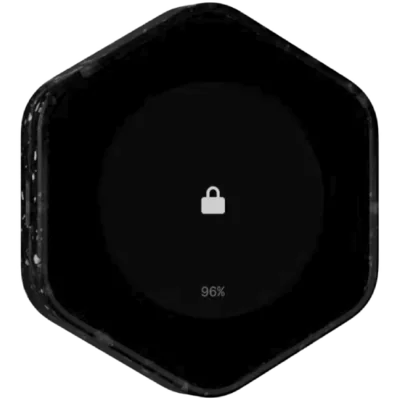
Bitkey is a hardware wallet made from Corian® solid-surface composite. Bitkey uses a 2-of-3 multisignature scheme: one key lives on the hardware device, one on the companion mobile app, and one on Block’s servers. Any transaction requires two of the three keys. The server key is encrypted and described as inaccessible without the customer’s participation.
The new hardware revision adds an OLED touchscreen and retains the fingerprint biometric sensor, NFC connectivity, and the Corian casing. Bitkey’s current product documentation emphasizes touchscreen and fingerprint interaction and does not describe traditional physical navigation buttons.
Key Handling and Custody
Bitkey explicitly has no user-facing seed phrase. There is no BIP39 mnemonic backup or export flow for the user. This is an intentional design choice. Bitkey instead promotes a seedless 2-of-3 multisig model with cloud-backed recovery and an “Emergency Exit Kit”. See How Bitkey Works and The end of seed phrase scams.
The practical consequence is more specific than that. If a user still has their hardware device, access to the encrypted Emergency Exit Kit PDF stored in their cloud account, and a compatible phone to run the Bitkey emergency recovery flow, Bitkey says its Emergency Exit Kit lets them move funds without relying on Block’s servers. In the current app code, the recovery flow asks the hardware device over NFC to unseal the EEK’s sealed key, stores that key in the app’s local encrypted CSEK store, and then restores the app spending key from the PDF payload. But if the user loses both their phone and hardware at the same time, recovery depends on having set up a Recovery Contact in advance and on Bitkey’s cloud-backed recovery flow.
Additionally, if the user enables Bitkey’s optional Transfer without hardware feature, Block’s server key can co-sign transactions up to the user’s configured spending limit without requiring the hardware device. In that mode, the hardware wallet is not a mandatory participant in all fund movements.
Whether this constitutes custody depends on framing:
- Block does not control funds unilaterally (2-of-3 always requires at least one of the customer’s keys).
- But Block can co-sign below the spending limit without hardware, and most recovery flows depend on Block’s servers.
- Users cannot export a standard user-facing BIP39 seed or restore Bitkey through a seed phrase.
Analysis
| Question | Answer | Evidence |
|---|---|---|
| Can the private keys be created offline? | Yes (hardware key) | Bitkey’s product page states: “Bitkey’s hardware key is generated and stored completely offline in a secure enclave.” The system also includes a server-held key (generated by Block) and an app key (generated on the phone during setup), neither of which is offline. The question applies to the hardware device key specifically. |
| Are the private keys shared? | No | The user’s hardware key and app key are never disclosed to Block. Block independently generates and holds a third key on its own servers — not a copy of the user’s keys. The wallet uses a 2-of-3 signing topology: the hardware key and app key can sign together without involving Block’s server at all. Block’s key is used in server-assisted signing paths, such as the optional Transfer without hardware feature, which allows co-signing up to the user’s spending limit when the hardware device is not present, and in recovery flows where the hardware is unavailable. Source: How Bitkey Works. |
| Does the device display the receive address? | Yes | Address verification on the hardware device is implemented in the app code and gated exclusively to W3 hardware (the 2026 device). When the user taps “Review on Bitkey,” the app opens an NFC session and calls commands.getAddress(session, index) on the hardware, which displays the address on the device’s OLED screen for verification. The prompt subline reads: “Display your address on your Bitkey for verification.” This feature is absent for the original screenless hardware. Source: AddressQrCodeUiStateMachineImpl.kt, AddressVerificationPromptBodyModel.kt at app/2026.7.0. |
| Does the interface have a display screen and buttons? | Yes | The new device has an OLED touchscreen display. The fingerprint sensor replaces traditional physical navigation buttons, serving as the primary input mechanism for unlocking and approving transactions. |
| Is the source available? | No (firmware) | The Android companion app source is available and has a verifiable build process. The firmware source is published under the MIT License at firmware/ in the same repository, but it cannot be built by external parties. The firmware README states: “we use a 3rd party fingerprint sensor that comes with a proprietary matching algorithm and we are contractually obligated not to publicly release the library that implements this functionality.” This is confirmed at the code level: firmware/hal/biometrics/src/fpc_biometrics.c includes six FPC BEP headers (fpc_bep_algorithms.h, fpc_bep_bio.h, fpc_bep_image.h, fpc_bep_sensor.h, fpc_bep_sensor_test.h, fpc_bep_types.h) and calls FPC BEP functions throughout. The build system (hal/biometrics/meson.build line 31) lists fpc_bep_dep as a required dependency. None of these headers exist anywhere in the repository, no compiled binary (.a, .so) is present, and fpc_bep_dep is never declared in any meson.build file. The dependency is wired in but has nothing to resolve to. |
Setup
- Download the Bitkey app.
- Open the app and choose “Set up new wallet.”
- Pair the hardware device with the app using NFC.
- Enroll the user’s fingerprint following the app’s prompts.
- Complete cloud backup (iCloud for iOS, Google account for Android).
- Establish recovery contact methods; email is mandatory.
Multisignature
- Three keys: hardware device, mobile app, Block’s servers.
- Two of three required to authorize any transaction.
- Standard spending: hardware device + mobile app. Block’s server is not involved.
- Transfer without hardware (optional): mobile app + Block’s server, up to the user’s configured spending limit, when the hardware device is not present.
Recovery Options
Available recovery options per Bitkey support:
- Cloud recovery: Lost/replaced phone with cloud backup available.
- Delay + Notify: Lost/replaced phone without cloud backup; or lost/replaced hardware device.
- Cloud Health Check: Lost/replaced cloud account.
- Trusted Contacts: Lost both hardware device and phone near simultaneously.
- Emergency Exit Kit: Bitkey app unavailable, or the user wants to exit without relying on Bitkey servers. The flow still requires the user’s Bitkey hardware device and a compatible phone (iOS or Android) to run the emergency recovery app. Bitkey says this was formerly called the Emergency Access Kit.
The first four recovery methods are still part of Bitkey’s hosted recovery design. The Emergency Exit Kit is different: Bitkey says it lets users move funds without connecting to Block or Bitkey servers. In app/2026.7.0, the W3 recovery state machine unseals the EEK key through the hardware over NFC and writes it to CsekStore before the payload restorer decrypts the app spending key.
Fingerprint Scanner
The fingerprint scanner unlocks the device and authorizes actions in the app. Bitkey says fingerprint authentication is currently the only supported way to secure and unlock the hardware device: Do I have to use a fingerprint to secure my Bitkey hardware device?
Verdict
As documented in the analysis above, the firmware source is published but cannot be built or independently verified by external parties — the required FPC fingerprint library is proprietary and entirely absent from the repository. Without the ability to build and verify this security-critical firmware, WalletScrutiny’s analysis stops here. Users must take Block’s word that the firmware running on the device matches the published source plus the closed source fingerprint library.
Verdict: nosource.
Firmware
Bitkey’s firmware source is published in the same repository as the app: github.com/proto-at-block/bitkey, under the firmware/ directory. The most recent source publish at the time of writing is commit 34c4399 (2026-04-24).
The firmware and app ship together under the same app/YEAR.WEEK.PATCH version scheme. There are no separate firmware-only release tags. The latest release is app/2026.7.0, published 2026-04-24.
Block publishes the firmware source under the MIT License. However, the firmware cannot be fully built by external parties as-is: the fingerprint sensor relies on a proprietary third-party matching library that Block is contractually prohibited from releasing. Stubs for that library must be implemented to produce a complete build. This is documented in the firmware README.
The build system is Meson, with an invoke wrapper. Toolchain management uses Hermit. The firmware communicates with the companion app over NFC using two interfaces: standard NDEF (used for firmware updates) and WCA (Wallet Custom APDUs — protobufs over APDUs, used for all other app-to-firmware communication). The WCA command set is documented in the repository.
Multi Signature
Bitcoin allows to define addresses controlled by more than one private key. Two-of-three for example would mean that any two of a list of three private keys would be required to send coins from this address.
With keys from distinct devices or users, an attacker would have to compromise multiple devices or users at once. Multi signature thus allows to protect against one device catching a virus, one wallet having a backdoor (if the multi signature works across different providers’ wallets), one hardware wallet not being trusted (if hardware wallets can be used for multi signature), etc.
- There are no good standards yet for multi signature accounts. This might mean that an account that works with one provider’s wallet won’t load in any other wallet which can complicate recovery should that wallet go out of business.
- Using Multi Signature results in bigger and thus more expensive transactions.
- Using Multi Signature accounts makes it easier for blockchain analysis companies to follow the trail of a wallet.
- Multi Signature accounts require backups of additional descriptors, making financial loss from user error more likely.
Why we list it for this wallet
Bitkey's 2-of-3 multisig setup is built into every wallet. You hold two keys: one on your Bitkey device and one in the app. A third is encrypted on a server and can't be used without one of your other keys.
Source: Website
Fingerprint Authentication
Fingerprint authentication in Bitcoin wallets enhances security by adding a biometric layer to the access control mechanisms. This feature leverages the unique patterns of a user’s fingerprint to grant access to the wallet, making unauthorized access significantly more difficult. Biometric authentication is generally faster and more convenient than traditional methods like passwords or PINs, as it eliminates the need to remember complex combinations. This form of authentication is particularly useful in mobile wallet applications, where ease of access and security are paramount. Fingerprint authentication minimizes the risk of phishing or brute force attacks that typically target password-based systems. Furthermore, it can be combined with other forms of security measures, like PINs or passwords, to create a multi-factor authentication system for added security. The use of biometric data, however, raises concerns regarding privacy and data security. Users must be assured that their biometric data is stored securely and not vulnerable to unauthorized access or breaches.
- Enhanced security through a unique, non-replicable form of identification
- Convenience and speed of access compared to traditional methods
- Reduced risk of phishing and brute force attacks
Potential privacy concerns and dependency on device hardware capabilities.
Why we list it for this wallet
Fingerprint authentication is currently the only supported way to secure and unlock the hardware device.
Source: Bitkey Support: Do I have to use a fingerprint to secure my Bitkey hardware device? (support.bitkey.world/hc/en-us/articles/18843390579860)
NFC (Near Field Communication)
The wallet supports Near Field Communication (NFC) for wireless interaction with hardware wallets, payment terminals, or signing cards. NFC enables tap-to-sign or tap-to-pay functionality over a very short range (typically a few centimeters) without cables or QR codes.
- Convenience: Quick tap interaction — no cables to connect or QR codes to scan.
- Hardware wallet compatibility: Some hardware signing cards communicate exclusively via NFC.
- Requires NFC hardware on both devices.
- Very short range limits usability compared to QR-based air-gapped setups.
Why we list it for this wallet
Connectivity: Near-field Communication (NFC). Phone Requirements: Android 7.0/Nougat or later and NFC capability.
Source: Bitkey Product Page: Specs (bitkey.world/product)
Product page updated by Daniel Andrei R. Garcia
Community Opinions
These comments are contributed by Nostr users.
Loading opinions…
Do your own research
In addition to reading our analysis, it is important to do your own checks. Before transferring any bitcoin to your wallet, look up reviews for the wallet you want to use. They should be easy to find. If they aren't, that itself is a reason to be extra careful.