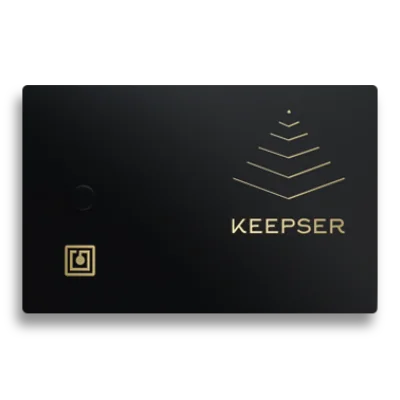
Keepser
Our wallet review process
We examine wallets starting at the code level and continue all the way up to the finished app that lives on your device. Provided below is an outline of each of these steps along with security tips for you and general test results.
Released
We could not determine when this product was originally released.
Custody
Private keys generated and held by user
As part of our Methodology, we ask: Is the provider ignorant of the keys?
The answer is "yes". Private keys are generated by the user on the wallet.
Read more
Source code
Not evaluated — our review stopped at an earlier step.
Build Verifications
Build cannot be done because the source code is not publicly available.Distribution
Passed 6 of 10 tests
We answered the following questions in this order:
We stopped asking questions after we encountered a failed answer.
The answer is "yes".
If the answer were "no", we would mark it as "Fake" and the following would apply:
The answer is "no". We marked it as "Fake".
We did not ask this question because we failed at a previous question.
If the answer were "no", we would mark it as "Fake" and the following would apply:
The bigger wallets often get imitated by scammers that abuse the reputation of the product by imitating its name, logo or both.
Imitating a competitor is a huge red flag and we urge you to not put any money into this product!
The answer is "yes".
If the answer were "no", we would mark it as "Announced but never delivered" and the following would apply:
The answer is "no". We marked it as "Announced but never delivered".
We did not ask this question because we failed at a previous question.
If the answer were "no", we would mark it as "Announced but never delivered" and the following would apply:
Some products are promoted with great fund raising, marketing and ICOs, to disappear from one day to the other a week later or they are one-man side projects that get refined for months or even years to still never materialize in an actual product. Regardless, those are projects we consider “vaporware”.
The answer is "yes".
If the answer were "no", we would mark it as "Un-Released" and the following would apply:
The answer is "no". We marked it as "Un-Released".
We did not ask this question because we failed at a previous question.
If the answer were "no", we would mark it as "Un-Released" and the following would apply:
We focus on products that have the biggest impact if things go wrong and while pre-sales sometimes reach many thousands to buy into promises that never materialize, the damage is limited and there would be little definite to be said about an unreleased product anyway.
If you find a product in this category that was released meanwhile, please contact us to do a proper review!
The answer is "yes".
If the answer were "no", we would mark it as "Not a wallet" and the following would apply:
The answer is "no". We marked it as "Not a wallet".
We did not ask this question because we failed at a previous question.
If the answer were "no", we would mark it as "Not a wallet" and the following would apply:
If it’s called “wallet” but is actually only a portfolio tracker, we don’t look any deeper, assuming it is not meant to control funds. What has no funds, can’t lose your coins. It might still leak your financial history!
If you can buy Bitcoins with this app but only into another wallet, it’s not a wallet itself.
The answer is "yes".
If the answer were "no", we would mark it as "A wallet but not for Bitcoin" and the following would apply:
The answer is "no". We marked it as "A wallet but not for Bitcoin".
We did not ask this question because we failed at a previous question.
If the answer were "no", we would mark it as "A wallet but not for Bitcoin" and the following would apply:
At this point we only look into wallets that at least also support BTC.
The answer is "yes".
If the answer were "no", we would mark it as "Provided private keys" and the following would apply:
The answer is "no". We marked it as "Provided private keys".
We did not ask this question because we failed at a previous question.
If the answer were "no", we would mark it as "Provided private keys" and the following would apply:
The best hardware wallet cannot guarantee that the provider deleted the keys if the private keys were put onto the device by them in the first place.
There is no way of knowing if the provider took a copy in the process. If they did, all funds controlled by those devices are potentially also under the control of the provider and could be moved out of the client’s control at any time at the provider’s discretion.
The product cannot be independently verified. If the provider puts your funds at risk on purpose or by accident, you will probably not know about the issue before people start losing money. If the provider is more criminally inclined he might have collected all the backups of all the wallets, ready to be emptied at the press of a button. The product might have a formidable track record but out of distress or change in management turns out to be evil from some point on, with nobody outside ever knowing before it is too late. The answer is "yes".
If the answer were "no", we would mark it as "Leaks Keys" and the following would apply:
The answer is "no". We marked it as "Leaks Keys".
We did not ask this question because we failed at a previous question.
If the answer were "no", we would mark it as "Leaks Keys" and the following would apply:
Some people claim their paper wallet is a hardware wallet. Others use RFID chips with the private keys on them. A very crucial drawback of those systems is that in order to send a transaction, the private key has to be brought onto a different system that doesn’t necessarily share all the desired aspects of a hardware wallet.
Paper wallets need to be printed, exposing the keys to the PC and the printer even before sending funds to it.
Simple RFID based devices can’t sign transactions - they share the keys with whoever asked to use them for whatever they please.
There are even products that are perfectly capable of working in an air-gapped fashion but they still expose the keys to connected devices.
This verdict is reserved for key leakage under normal operation and does not apply to devices where a hack is known to be possible with special hardware.
The product cannot be independently verified. If the provider puts your funds at risk on purpose or by accident, you will probably not know about the issue before people start losing money. If the provider is more criminally inclined he might have collected all the backups of all the wallets, ready to be emptied at the press of a button. The product might have a formidable track record but out of distress or change in management turns out to be evil from some point on, with nobody outside ever knowing before it is too late. The answer is "yes".
If the answer were "no", we would mark it as "Bad Interface" and the following would apply:
The answer is "no". We marked it as "Bad Interface".
We did not ask this question because we failed at a previous question.
If the answer were "no", we would mark it as "Bad Interface" and the following would apply:
These are devices that might generate secure private key material, outside the reach of the provider but that do not have the means to let the user verify transactions on the device itself. This verdict includes screen-less smart cards or USB-dongles.
The wallet lacks either a screen or buttons or both. In consequence, crucial elements of approving transactions is being delegated to other hardware such as a general purpose PC or phone which defeats the purpose of a hardware wallet. For big exit scams, a companion app could always request two signatures - one for the coffee you are paying and a second to empty your wallet completely. The former could be broadcast while the latter only gets collected for later use.
Another consquence of a missing screen is that the user is faced with the dilemma of either not making a backup or having to pass the backup through an insecure device for display or storage.
The software of the device might be perfect but this device cannot be recommended due to this fundamental flaw.
The product cannot be independently verified. If the provider puts your funds at risk on purpose or by accident, you will probably not know about the issue before people start losing money. If the provider is more criminally inclined he might have collected all the backups of all the wallets, ready to be emptied at the press of a button. The product might have a formidable track record but out of distress or change in management turns out to be evil from some point on, with nobody outside ever knowing before it is too late. The answer is "yes".
If the answer were "no", we would mark it as "No source for current release found" and the following would apply:
The answer is "no". We marked it as "No source for current release found".
We did not ask this question because we failed at a previous question.
If the answer were "no", we would mark it as "No source for current release found" and the following would apply:
A wallet that claims to not give the provider the means to steal the users’ funds might actually be lying. In the spirit of “Don’t trust - verify!” you don’t want to take the provider at his word, but trust that people hunting for fame and bug bounties could actually find flaws and back-doors in the wallet so the provider doesn’t dare to put these in.
Back-doors and flaws are frequently found in closed source products but some remain hidden for years. And even in open source security software there might be catastrophic flaws undiscovered for years.
An evil wallet provider would certainly prefer not to publish the code, as hiding it makes audits orders of magnitude harder.
For your security, you thus want the code to be available for review.
If the wallet provider doesn’t share up to date code, our analysis stops there as the wallet could steal your funds at any time, and there is no protection except the provider’s word.
“Up to date” strictly means that any instance of the product being updated without the source code being updated counts as closed source. This puts the burden on the provider to always first release the source code before releasing the product’s update. This paragraph is a clarification to our rules following a little poll.
We are not concerned about the license as long as it allows us to perform our analysis. For a security audit, it is not necessary that the provider allows others to use their code for a competing wallet. You should still prefer actual open source licenses as a competing wallet won’t use the code without giving it careful scrutiny.
The product cannot be independently verified. If the provider puts your funds at risk on purpose or by accident, you will probably not know about the issue before people start losing money. If the provider is more criminally inclined he might have collected all the backups of all the wallets, ready to be emptied at the press of a button. The product might have a formidable track record but out of distress or change in management turns out to be evil from some point on, with nobody outside ever knowing before it is too late.Application information
- It works with a companion app

- The app is geo-restricted, and requires NFC capability.
Updated Review 2023-12-14
The Pro and Pro+ models describes the function that allows the storage, management and exchange of cryptocurrencies. The keys are shared with the companion app.
Previous Review 2023-09-27
Despite its name, “Keepser Cold Wallet”, we find that the only function related to it being a wallet is that it can store private keys or seed phrases.
We did not find any documentation of its ability to sign transactions, generate wallets or receive cryptocurrencies via the public keys.
Nevertheless, we did find these statements in their Pro+ models, which make us want to take a secondary look:
You can automatically generate your public address from your private key with this list of cryptocurrencies:
and,
Store, manage, share and exchange your cryptocurrencies with just a tap (Only Pro and Pro+ models)
We sent them a query via their website’s contact form, but for the meanwhile, mark this as not a wallet:
Hello,
I am a researcher working for an Open Source organization called walletscrutiny. We look into apps and devices that claim to perform the functions of a bitcoin wallet.
We find your product very interesting.
But there are some points of clarification that we’d like to know:
From our initial assessment, we see that the card definitively allows users to store private keys - but not sign transactions. Is this correct?
Yet, from your website, we see statements such as:
You can automatically generate your public address from your private key with this list of cryptocurrencies:
While this is true, we don’t see this in the documentation - unless we are mistaken.
For the meanwhile, absent proof that the device or the app can sign cryptocurrency transactions, we’ll have to treat this like a hardware password manager.
We would appreciate your feedback.
Thank you.
Previous Review 2022-03-23
Features
- Possibility of storing 50 or 100 Keeps (usernames & passwords, bank cards, cryptocurrencies, seed phrases, loyalty cards).
- Contactless technology / NFC (Near Field Communication)
- Managing an RSA 4096 key
- Long-term storage solution. Keepser is guaranteed for 30 years.
- Resistance to strong attacks. Possibility of adding up to 5 additional security layers. (geolocation, Wi-Fi code, QR code, bar code, etc.)
- Program Keepser to visualize sensitive data with geolocation (3 different locations with an accuracy of 2/3m)
- Almost unbreakable, submersible: it stands extreme operating conditions (-40 ° to + 85 °C)
- Storage of several cryptocurrencies.
- Multilingual application in 3 languages: English, French, Spanish and soon available in other languages.
Card Variations
The Keepser has 3 card models advertised for cold wallets:
- Keepser Pro - 285€
Keepser Pro is an offline password manager + a cold wallet. It has the same functions as the Keepser PASS and also stores your cryptocurrencies and seed phrases.
- Keepser Pro+ - 349€
Keepser Pro+ is an offline password manager + a cold wallet. It has the same functions as the Keepser PASS and also stores your cryptocurrencies and seed phrases.
- Keepser Safe Clone - 219€
Along with the Keepser Cold Wallet, customers can purchase and take advantage of a “Keepser Safe Clone”. This white card enables instant back-up and restore mechanisms for your Keepser Cold Wallet (cloning, back-up, selective copy).
Verdict
The Pro and the Pro+, are the models that are related to cryptocurrency. They require a companion app and an NFC enabled Android phone:
To use this application you need a Keepser NFC cold wallet that embeds Freemindtronic’s EviToken technology and an Android NFC phone from Android KitKat 4.4, API 19
Apart from that, the Keepser does not have its own screen display interface making it reliant on the companion app.
It also does not mention whether it is open source.
The wallet is still in Pre-Order stage and bulk orders require emailing Keepser directly.
Product page updated by Daniel Andrei R. Garcia
Do your own research
In addition to reading our analysis, it is important to do your own checks. Before transferring any bitcoin to your wallet, look up reviews for the wallet you want to use. They should be easy to find. If they aren't, that itself is a reason to be extra careful.