Bying K1
Our wallet review process
We examine wallets starting at the code level and continue all the way up to the finished app that lives on your device. Provided below is an outline of each of these steps along with security tips for you and general test results.
Released
We could not determine when this product was originally released.
Custody
Private keys generated and held by user
But This product went out of business ... or so. Read the analysis for details.
As part of our Methodology, we ask: Is the provider ignorant of the keys?
The answer is "yes". Private keys are generated by the user on the wallet.
Read more
Source code
Application build
Build cannot be done because the source code is not publicly available.Passed 1 of 10 tests
We answered the following questions in this order:
We stopped asking questions after we encountered a failed answer.
The answer is "yes".
If the answer were "no", we would mark it as "Fake" and the following would apply:
The answer is "no". We marked it as "Fake".
We did not ask this question because we failed at a previous question.
If the answer were "no", we would mark it as "Fake" and the following would apply:
The bigger wallets often get imitated by scammers that abuse the reputation of the product by imitating its name, logo or both.
Imitating a competitor is a huge red flag and we urge you to not put any money into this product!
The answer is "yes".
If the answer were "no", we would mark it as "Announced but never delivered" and the following would apply:
The answer is "no". We marked it as "Announced but never delivered".
We did not ask this question because we failed at a previous question.
If the answer were "no", we would mark it as "Announced but never delivered" and the following would apply:
Some products are promoted with great fund raising, marketing and ICOs, to disappear from one day to the other a week later or they are one-man side projects that get refined for months or even years to still never materialize in an actual product. Regardless, those are projects we consider “vaporware”.
The answer is "yes".
If the answer were "no", we would mark it as "Un-Released" and the following would apply:
The answer is "no". We marked it as "Un-Released".
We did not ask this question because we failed at a previous question.
If the answer were "no", we would mark it as "Un-Released" and the following would apply:
We focus on products that have the biggest impact if things go wrong and while pre-sales sometimes reach many thousands to buy into promises that never materialize, the damage is limited and there would be little definite to be said about an unreleased product anyway.
If you find a product in this category that was released meanwhile, please contact us to do a proper review!
The answer is "yes".
If the answer were "no", we would mark it as "Not a wallet" and the following would apply:
The answer is "no". We marked it as "Not a wallet".
We did not ask this question because we failed at a previous question.
If the answer were "no", we would mark it as "Not a wallet" and the following would apply:
If it’s called “wallet” but is actually only a portfolio tracker, we don’t look any deeper, assuming it is not meant to control funds. What has no funds, can’t lose your coins. It might still leak your financial history!
If you can buy Bitcoins with this app but only into another wallet, it’s not a wallet itself.
The answer is "yes".
If the answer were "no", we would mark it as "A wallet but not for Bitcoin" and the following would apply:
The answer is "no". We marked it as "A wallet but not for Bitcoin".
We did not ask this question because we failed at a previous question.
If the answer were "no", we would mark it as "A wallet but not for Bitcoin" and the following would apply:
At this point we only look into wallets that at least also support BTC.
The answer is "yes".
If the answer were "no", we would mark it as "Provided private keys" and the following would apply:
The answer is "no". We marked it as "Provided private keys".
We did not ask this question because we failed at a previous question.
If the answer were "no", we would mark it as "Provided private keys" and the following would apply:
The best hardware wallet cannot guarantee that the provider deleted the keys if the private keys were put onto the device by them in the first place.
There is no way of knowing if the provider took a copy in the process. If they did, all funds controlled by those devices are potentially also under the control of the provider and could be moved out of the client’s control at any time at the provider’s discretion.
The product cannot be independently verified. If the provider puts your funds at risk on purpose or by accident, you will probably not know about the issue before people start losing money. If the provider is more criminally inclined he might have collected all the backups of all the wallets, ready to be emptied at the press of a button. The product might have a formidable track record but out of distress or change in management turns out to be evil from some point on, with nobody outside ever knowing before it is too late.
The answer is "yes".
If the answer were "no", we would mark it as "Leaks Keys" and the following would apply:
The answer is "no". We marked it as "Leaks Keys".
We did not ask this question because we failed at a previous question.
If the answer were "no", we would mark it as "Leaks Keys" and the following would apply:
Some people claim their paper wallet is a hardware wallet. Others use RFID chips with the private keys on them. A very crucial drawback of those systems is that in order to send a transaction, the private key has to be brought onto a different system that doesn’t necessarily share all the desired aspects of a hardware wallet.
Paper wallets need to be printed, exposing the keys to the PC and the printer even before sending funds to it.
Simple RFID based devices can’t sign transactions - they share the keys with whoever asked to use them for whatever they please.
There are even products that are perfectly capable of working in an air-gapped fashion but they still expose the keys to connected devices.
This verdict is reserved for key leakage under normal operation and does not apply to devices where a hack is known to be possible with special hardware.
The product cannot be independently verified. If the provider puts your funds at risk on purpose or by accident, you will probably not know about the issue before people start losing money. If the provider is more criminally inclined he might have collected all the backups of all the wallets, ready to be emptied at the press of a button. The product might have a formidable track record but out of distress or change in management turns out to be evil from some point on, with nobody outside ever knowing before it is too late.
The answer is "yes".
If the answer were "no", we would mark it as "Bad Interface" and the following would apply:
The answer is "no". We marked it as "Bad Interface".
We did not ask this question because we failed at a previous question.
If the answer were "no", we would mark it as "Bad Interface" and the following would apply:
These are devices that might generate secure private key material, outside the reach of the provider but that do not have the means to let the user verify transactions on the device itself. This verdict includes screen-less smart cards or USB-dongles.
The wallet lacks either a screen or buttons or both. In consequence, crucial elements of approving transactions is being delegated to other hardware such as a general purpose PC or phone which defeats the purpose of a hardware wallet. For big exit scams, a companion app could always request two signatures - one for the coffee you are paying and a second to empty your wallet completely. The former could be broadcast while the latter only gets collected for later use.
Another consquence of a missing screen is that the user is faced with the dilemma of either not making a backup or having to pass the backup through an insecure device for display or storage.
The software of the device might be perfect but this device cannot be recommended due to this fundamental flaw.
The product cannot be independently verified. If the provider puts your funds at risk on purpose or by accident, you will probably not know about the issue before people start losing money. If the provider is more criminally inclined he might have collected all the backups of all the wallets, ready to be emptied at the press of a button. The product might have a formidable track record but out of distress or change in management turns out to be evil from some point on, with nobody outside ever knowing before it is too late.
The answer is "yes".
If the answer were "no", we would mark it as "No source for current release found" and the following would apply:
The answer is "no". We marked it as "No source for current release found".
We did not ask this question because we failed at a previous question.
If the answer were "no", we would mark it as "No source for current release found" and the following would apply:
A wallet that claims to not give the provider the means to steal the users’ funds might actually be lying. In the spirit of “Don’t trust - verify!” you don’t want to take the provider at his word, but trust that people hunting for fame and bug bounties could actually find flaws and back-doors in the wallet so the provider doesn’t dare to put these in.
Back-doors and flaws are frequently found in closed source products but some remain hidden for years. And even in open source security software there might be catastrophic flaws undiscovered for years.
An evil wallet provider would certainly prefer not to publish the code, as hiding it makes audits orders of magnitude harder.
For your security, you thus want the code to be available for review.
If the wallet provider doesn’t share up to date code, our analysis stops there as the wallet could steal your funds at any time, and there is no protection except the provider’s word.
“Up to date” strictly means that any instance of the product being updated without the source code being updated counts as closed source. This puts the burden on the provider to always first release the source code before releasing the product’s update. This paragraph is a clarification to our rules following a little poll.
We are not concerned about the license as long as it allows us to perform our analysis. For a security audit, it is not necessary that the provider allows others to use their code for a competing wallet. You should still prefer actual open source licenses as a competing wallet won’t use the code without giving it careful scrutiny.
The product cannot be independently verified. If the provider puts your funds at risk on purpose or by accident, you will probably not know about the issue before people start losing money. If the provider is more criminally inclined he might have collected all the backups of all the wallets, ready to be emptied at the press of a button. The product might have a formidable track record but out of distress or change in management turns out to be evil from some point on, with nobody outside ever knowing before it is too late.Application information
Update 2024-10-18
On its Telegram channel we read a post in 2023, we read:
Bying, [9/20/22 10:23 AM] 诈骗事件频发,请务必警惕假官网和假应用!
近期 Bying 发现诈骗团伙在多个渠道诱导用户打开假的 Bying官网,因此导致用户资产被盗。欺诈事件频发,需要我们不断提高辨别假App和官网的能力。Bying根据近期社区发生的一些安全事件,总结并在这里提醒各位用户:
下载安装 Bying ,请大家认准Bying 唯一官网:https://web.archive.org/web/20240901101046/http://www.bying.io/ 其他所有的均为假冒 Bying 网站,请仔细核对,避免造成资产损失。
Bying钱包目前只有手机客户端,无PC网页端APP,请谨慎防范任何与 Bying 唯一官网(https://bying.xn–io),-o84fhcv3fdzau53c0ga0c207dyxa7a5775d2b2aga39rfy5eea6508fq3dc97bw1ehnk.#deadLink
私钥助记词的保存和使用都不要经过网络传输和备份,因为一旦发生泄露,资产安全就无法得到保障!
不可相信任何自称官方的人员!
私钥助记词等不可提供给任何第三方!
不可随意打开第三方的链接并授权,当前恶意授权、合约调用转账、私钥助记词盗取等方式导致资产丢失的案件发生较多!请大家务必做好提升个人安全意识!
最后再提醒一遍!!!请认准Bying 唯一官网:https://web.archive.org/web/20240901101046/http://www.bying.io/
Translated using Google Translate:
Bying, [9/20/22 10:23AM]
Fraud incidents occur frequently, please be careful of fake official websites and fake applications!Recently, Bying found that fraud gangs induced users to open fake Bying official websites through multiple channels, which led to the theft of user assets. Fraud incidents occur frequently, and we need to continuously improve our ability to identify fake apps and official websites. Based on some security incidents that have occurred in the community recently, Bying summarizes and reminds all users here:
Download and install Bying, please identify Bying’s only official website: https://web.archive.org/web/20240901101046/http://www.bying.io/
All others are fake Bying websites, please check carefully to avoid asset losses.Bying wallet currently only has a mobile client, no PC web APP. Be cautious of any URL similar to Bying’s only official website (https://web.archive.org/web/20240901101046/http://www.bying.io/), and there are certain risks in downloading from non-official channels.
The storage and use of private key mnemonics should not be transmitted or backed up over the Internet, because once a leak occurs, the security of assets cannot be guaranteed!
Do not trust anyone who claims to be official!
Private key mnemonics, etc., cannot be provided to any third party!
Do not open third-party links and authorize them at will. Currently, there are many cases of asset loss caused by malicious authorization, contract transfer, private key mnemonics theft, etc.! Please be sure to improve your personal safety awareness!
Finally, remind me again!!! Please look for Bying’s only official website: https://web.archive.org/web/20240901101046/http://www.bying.io/
However, when we visited the website, it is no longer available and its domain has expired since 08-28-2024. With no other corroborating information that this product exists, we are marking it as vapor until new information comes along.
Background Information 2023-11-17
Bying K1 is a Chinese product and does not have much social media presence besides the company’s Twitter account. This account has not seen activity since early 2020.
However there is still a working link to the shop. Here it claims to ship to “Beijing-Chaoyang District.”
Product Description
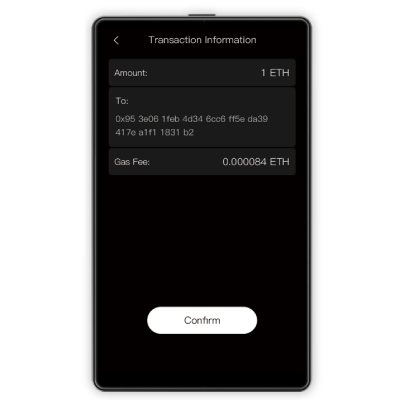
Here are some of the features it advertises on the product page:
- Never connect to network: Use hot wallet to initiate a transaction and cold wallet to sign the transaction
- Powerful Efuse security chip: Use original program to prevent hacker from tampering
- Anti-tamper mechanism of financial grade: Wallet data will be automatically erased while someone separate the hardware wallet
Technical Specifications
- Thickness: 7.88mm
- Screen: 4inch IPS 640*1136pixels
- Battery: standby time up to 20 days
Analysis
From the FAQ:
Watch cold wallet means binding cold wallet to hot wallet. Cold wallet never connect to network so you need Bying wallet App to help you update balance and send transactions.
Cold wallet will remind you to watch after you create a wallet. Use Bying wallet App to scan the QR Code that on the cold wallet to watch your cold wallet. Be sure to watch your cold wallet before collection, or else you may get a wrong balance.
This hardware wallet can generate private keys and will provide you with your mnemonics and is an offline wallet.
We could not find any information about the source code. Additionally, its unclear if the product is available to those outside of Beijing.
Update 2023-11-17
The product buy page is still labelled as “Pre-Order”, meaning it has not yet been released.
Product page updated by Daniel Andrei R. Garcia
Do your own research
In addition to reading our analysis, it is important to do your own checks. Before transferring any bitcoin to your wallet, look up reviews for the wallet you want to use. They should be easy to find. If they aren't, that itself is a reason to be extra careful.
<img src="https://walletscrutiny.com/images/social/hardware/bying.k1.png">